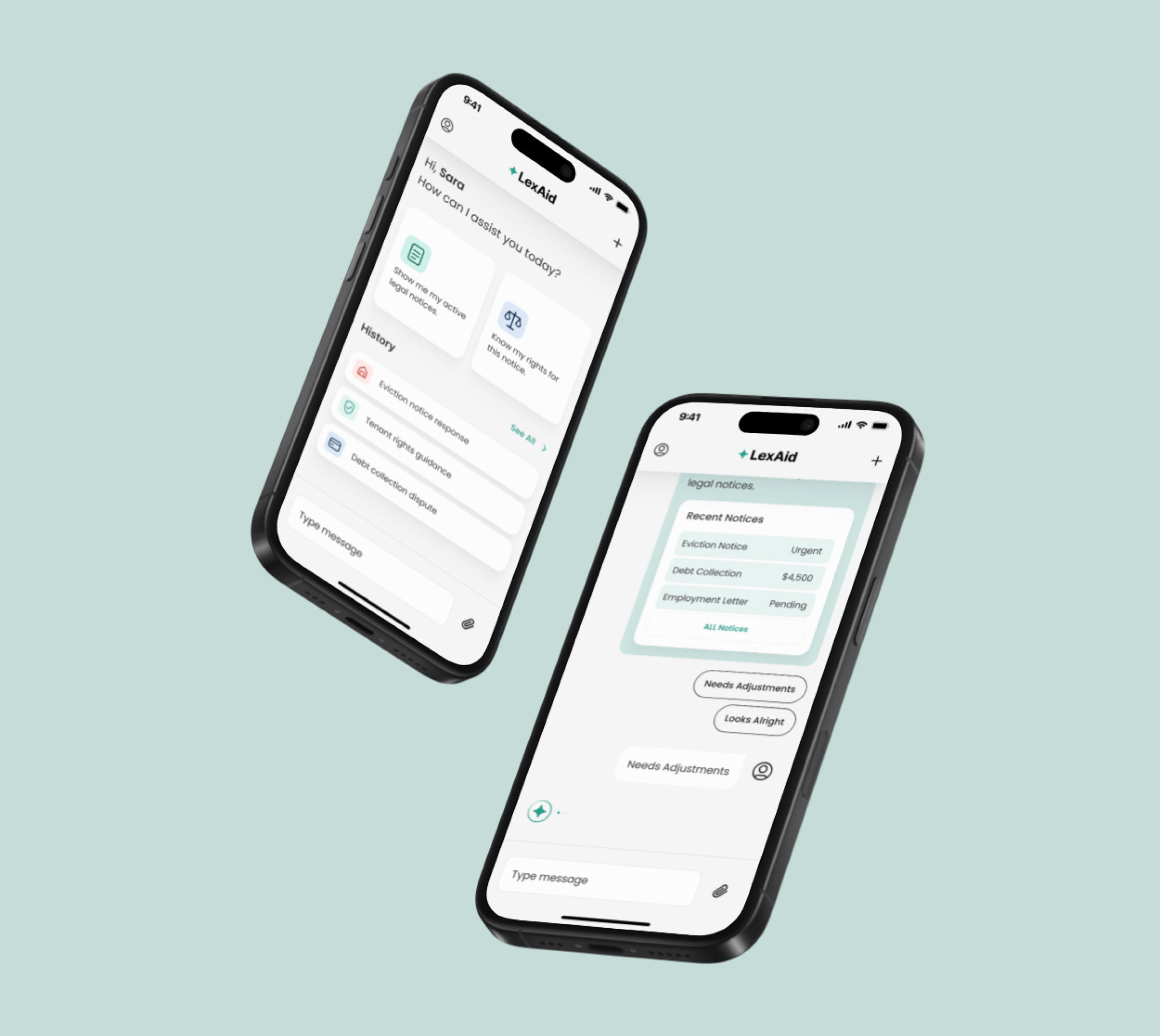
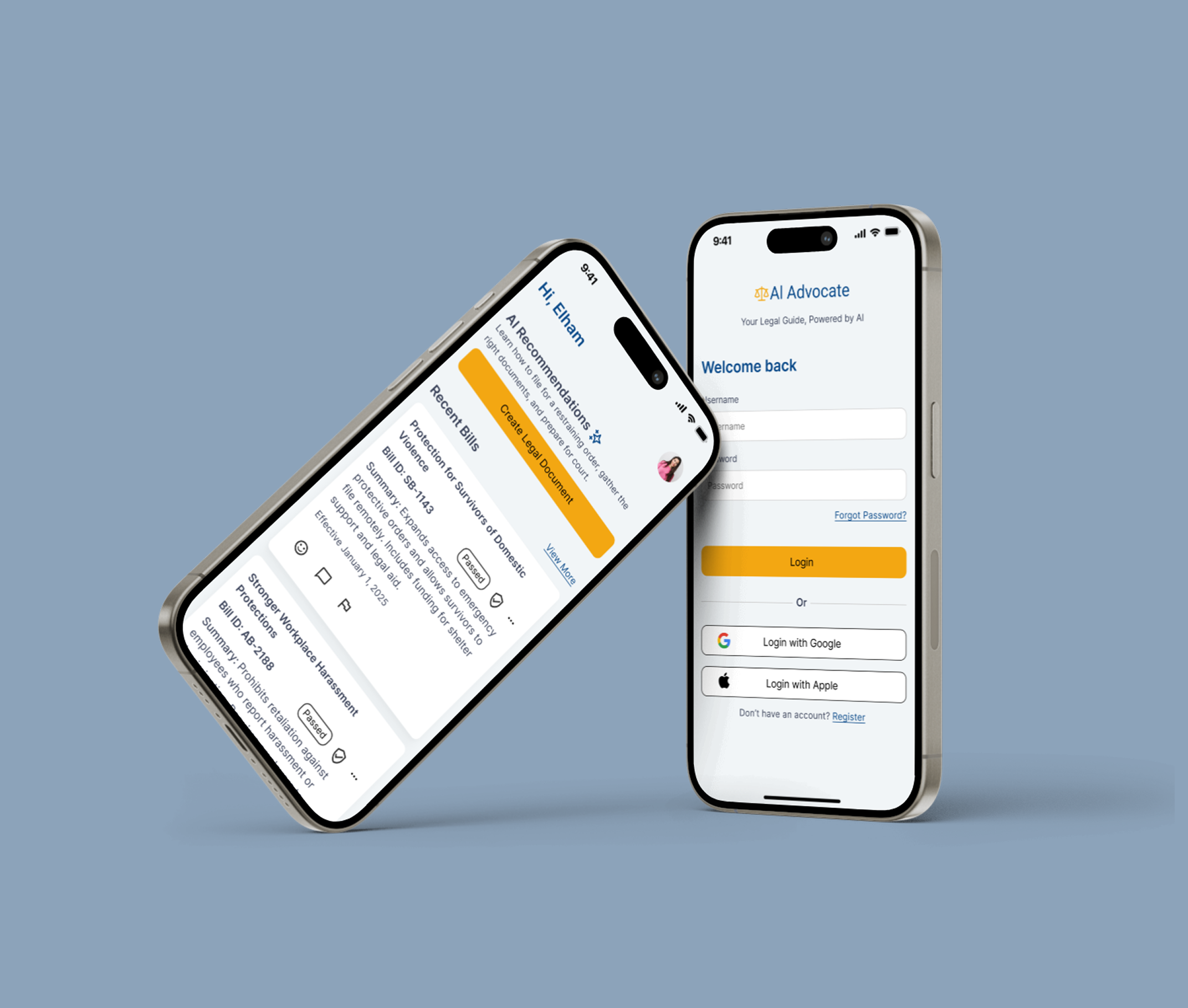
AI-powered mobile app simplifying complex legislation language into accessible, actionable guidance
Client
Love Never Fails
Role
Project Manager and Product Designer
Held both roles at once, for the full 16 weeks.
Duration
16 weeks
Platform
Mobile
The app targets California's 26,032,160 voting-eligible residents, with a wider goal of expansion across the United States. The ultimate goal: getting the most underserved communities educated and engaged in the civic process.
Delivered 100+ screens across 3 complete flows, including a full component library, style guide, interactive prototype, and complete documentation, handed off ready to build.
Research revealed the problem was universal, not unique to LNF's survivor community, expanding the app's audience to any Californian navigating complex legislation.
The Develop for Good team displayed utmost professionalism, not only in their technical work, but also in their communication, collaboration, and organization. The UX/UI design they created for our mobile app not only met, but surpassed every criteria we set. In addition, the documentation they provided was detailed, concise, clear, and easy to navigate. We are extremely happy with what they have created for us, and would not hesitate to recommend any individual member of the team for any future project.
Sergio Di Martino
Project Liaison, Love Never Fails
Love Never Fails is a nonprofit supporting survivors of human trafficking across California. They wanted to build a mobile app that could help their community understand the legislation that directly affects their lives.
The problem? That legislation was written in dense legal language most people couldn't parse, and no existing tool could simplify it, adapt it to different reading levels, and guide people toward acting on what they learned.
Design a mobile app that uses AI to make California legislation readable, understandable, and actionable, regardless of a person's education level or language.
I led the project as both Product Manager and Product Designer, owning the research, the PRD, the design, and the handoff. I worked alongside a Design Manager, 5 designers, and the Love Never Fails team for 16 weeks.
Legislative bills are written at a college reading level, full of jargon, long sentences, and legal terminology that's nearly impossible to parse without formal training.
Users didn't know where to find reliable legal information. They pieced things together from social media, friends, and search results, with no way to verify what was accurate.
Even when users understood a law existed to protect them, they didn't know what to do about it. Understanding and acting are different things, and the gap left people feeling stuck.
Initial challenge
I met with Love Never Fails to understand their mission, their community, and what they actually needed the app to do.
I ran two rounds of surveys, reviewed five published studies on legislative complexity, and looked at three AI products to understand where people lose trust in AI tools.
I partnered with my teammates to run HMW sessions, build empathy maps, and develop user stories and use cases.
I worked with two technically minded designers to validate the API and architecture before designing anything.
I designed lo-fi through hi-fi screens in Figma and tested the mid-fidelity prototype with five LNF community members. Testing surfaced a real gap: users could read a simplified bill summary but had no way to act on it. In response, I designed a new flow, an interactive questionnaire that walks users through their situation and drafts the relevant legal document from their answers, with the option to edit or save. That shift moved the app from explaining the law to helping people act on it, the actual goal from day one.
I compiled everything from research, ideation, and user testing, along with the complete Figma file, into a final handoff package for the client. The team then presented the full project, answered every question and concern, and added supporting notes to guide next steps.
The Output
Everything below came out of that six-step process: research synthesis, information architecture, user flows, wireframes, and 100+ high-fidelity screens across three complete flows, delivered with a component library, a style guide, and an interactive prototype.
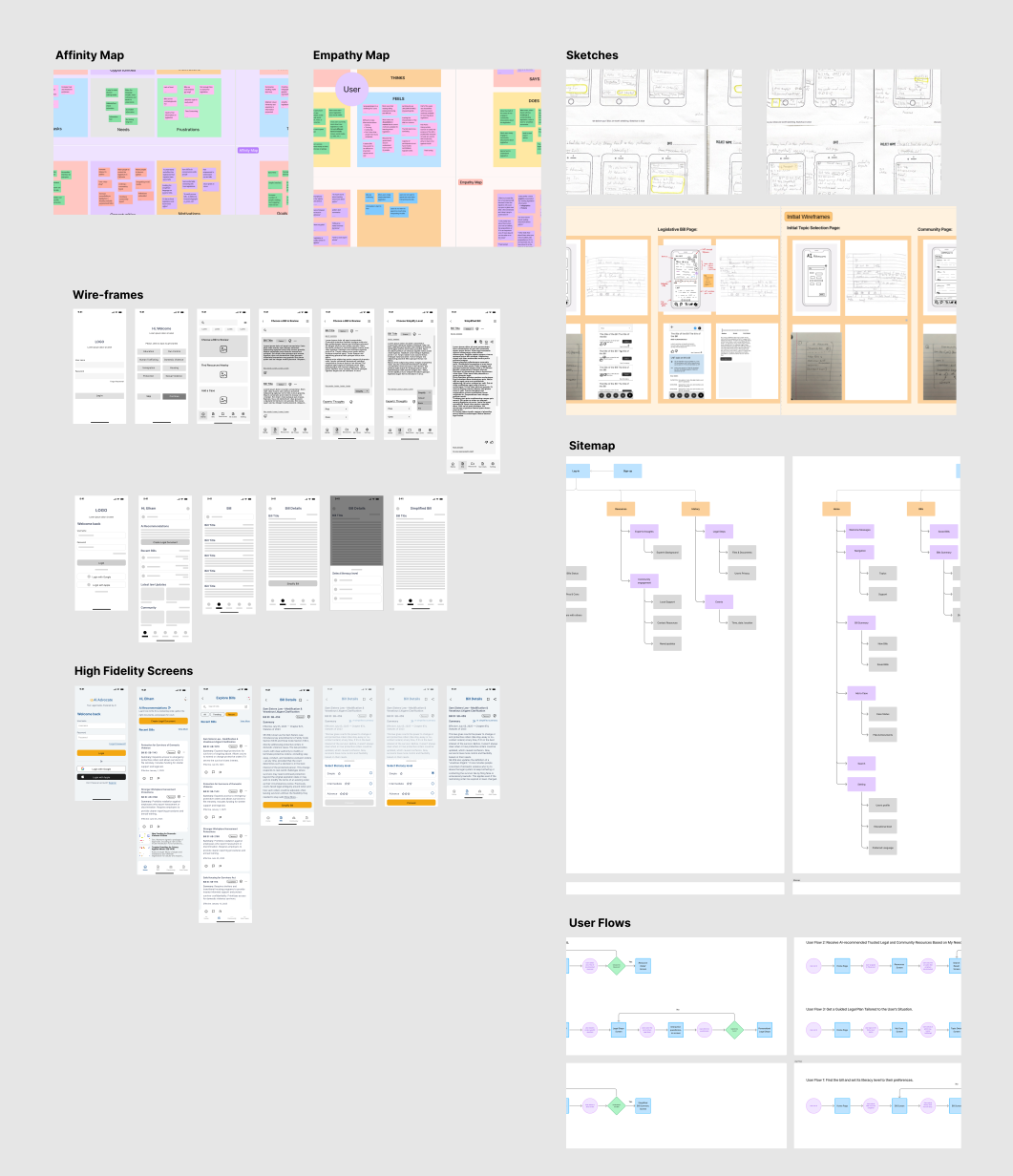
The project was originally scoped for LNF's survivor community. But research showed the problem was universal, even people with PhDs struggled with legal language. Mid-project, I redesigned the survey, expanded the audience, and rethought the entire information architecture.
I followed the research instead of the original brief. That meant redesigning the survey, expanding the target audience, and reworking the information architecture to serve a much broader group. It added real work mid-project, but it turned a tool for one community into a resource for every Californian navigating the law, a tradeoff worth making.
Testing showed 60+ second load times for real-time NLP simplification, a deal breaker. LNF also couldn't fund their own AI model, so we worked with Gemini and a pre-curated legal library, and proposed pre-processing bills in advance to eliminate the delay entirely.
By validating the API and architecture before designing a single screen, I caught the processing bottleneck early enough to solve it as an engineering decision, not a design patch. We moved to Gemini with a pre-curated legal library and pre-processed bills in advance, so the 60-second wait disappeared before it ever reached a user.
Midway through the project, the design lead and two other designers left the team unexpectedly, right as we were entering the most demanding phase of the work, with a fixed client deadline that couldn't move.
I promoted one of the remaining designers into the lead role and redistributed the work across the four of us who stayed. We tightened our process, and kept the client informed every step of the way, delivering every core feature on the original 16-week timeline.
How It Landed
Delivered within the 16-week timeline, nothing cut.
Presented to Develop for Good and the client team.
Handed to Love Never Fails complete and documented.
What it took to get there
I went in expecting to design for survivors of human trafficking. The research told me the problem was universal. Being willing to let go of the original brief and follow what the data said, even when it meant more work, led to a product with 26 million times more potential impact.
When the stakes are high, legal rights, safety, justice, users need to trust the tool before they'll use it. Every decision around source citations, expert review, and transparent AI output came from understanding that trust is a design problem, not a marketing one.
Validating the API, proposing the pre-processing architecture, consulting an engineer on privacy, none of that was strictly a design responsibility. But doing it made the designs buildable, credible, and handoff-ready. Great design work often crosses into adjacent disciplines.